
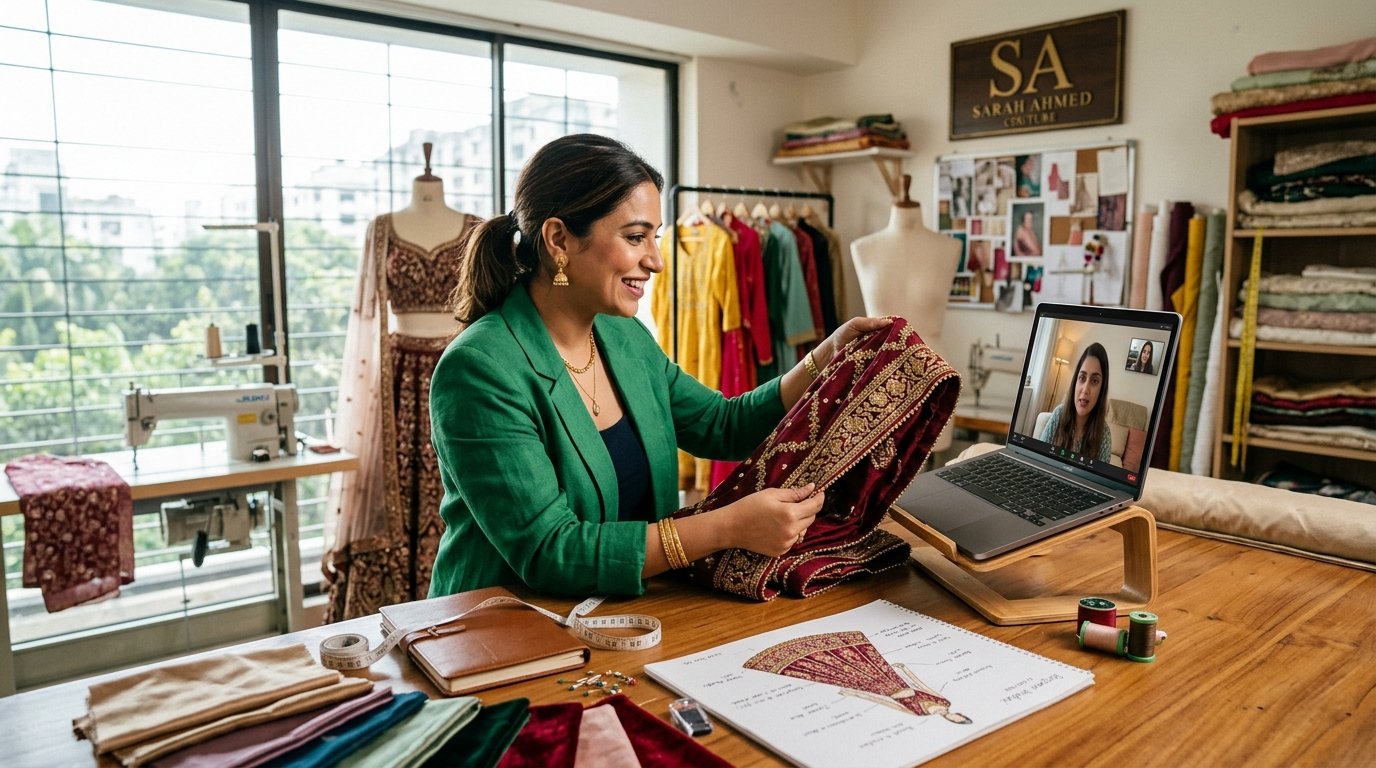
For South Asian fashion designers, bridal couturiers, and bespoke tailoring houses, catering to the global diaspora—Non-Resident Indians (NRIs), British Asians, and Indo-Canadians/Americans—is arguably the highest-margin segment in the apparel industry.
A bride living in London, San Jose, or Toronto planning a 4-day wedding celebration frequently spends between $3,000 and $12,000+ (₹2,50,000 to ₹10,00,000+) on her trousseau and family outfits. Because local tailoring options in North America and Western Europe are limited, prohibitively expensive, or lack authentic hand-embroidered craftsmanship, these clients enthusiastically turn to premier ateliers in Mumbai, Delhi, Bengaluru, Lahore, and Dubai.
Yet, managing custom garments for a client who lives 8,000 miles away presents unique operational hazards: self-measurement inaccuracies, international time-zone confusion, currency conversion disputes, and strict customs shipping deadlines.
In this guide, we outline the exact operational playbook top fashion labels use to manage overseas bespoke orders smoothly, profitably, and without costly fitting re-dos.
The 3 Major Pitfalls of Long-Distance Tailoring
When a local client tries on a blouse or sherwani that is slightly tight across the bust or armhole, your in-house alteration tailor opens the side seam in 15 minutes. But when an overseas client receives an ill-fitting garment 5 days before her sister's wedding, the outcome is ruined brand reputation, frantic overnight shipping costs, or costly chargebacks.
The root causes almost always fall into three categories:
1. The "Kitchen Tape Measure" Mistake
Asking an overseas customer to "send their measurements on WhatsApp" results in catastrophe. Clients frequently use rigid steel hardware measuring tapes, measure themselves while looking down (distorting back length and shoulder width), or measure over heavy winter clothing.
2. Payment Friction & Opaque Currency Conversions
Quoting an overseas client in Indian Rupees (INR) and expecting them to execute complex international wire transfers creates hesitation and delays. Foreign banks deduct hidden intermediary SWIFT fees, causing the received funds to be short by $45 to $75 per transaction.
3. Customs Clearance Delays & Missing Invoices
Shipping hand-embroidered garments internationally without correct Harmonized Tariff System (HS) codes, commercial invoices, and proper fabric declarations leads to shipments stuck in US or UK customs for weeks.
The 4-Step Virtual Fitting & Consultation Framework
Top couture studios have replaced informal phone calls with a structured, luxury virtual consultation protocol:
Step 1: The Pre-Consultation Style Questionnaire
Before scheduling a 45-minute video call, send the client a short digital form capturing event date, venue climate (e.g., outdoor California summer vs. heated UK ballroom), silhouette preferences, color palette, and budget in their local currency ($ / £ / € / CAD).
Step 2: Guided Live Video Measurement Verification
Never rely purely on written numbers submitted by the client. Schedule a 20-minute Zoom or WhatsApp video session where your senior stylist or master cutter guides the client live:
- Ensure the client wears fitted athletic clothing (leggings and a sports bra) and their planned heel height.
- Instruct a family member or friend to hold the tape while your cutter observes posture via video screen.
- Record full-body front, profile, and back reference screenshots (with client permission) directly into the customer's digital measurement file to capture posture nuances (such as erect spine, sloping shoulders, or asymmetric hip height).

Step 3: Built-In Alteration Margins (The "NRI Seam Allowance")
Master tailors who specialize in cross-border couture always engineer an intentional 2.5 to 3.0 inch internal seam margin with 3-step chain stitching on side seams, sleeve inseams, and waistbands.
If the client gains or loses weight during the 4 months leading up to her wedding, any local dry cleaner or seamstress in her home city can let out or take in the garment in 10 minutes without disrupting the front embroidery or structural boning.
Step 4: Video Garment Walkthrough Prior to Dispatch
Before packaging the lehenga, gown, or sherwani into international dispatch boxes, place the completed outfit on an adjustable tailor mannequin set to the client's exact measurements.
Record a 90-second high-definition video walkthrough showcasing the embroidery, zip operation, inner lining finish, and tape measure confirming key lengths (e.g., lehenga waistband to floor, blouse bust and length). Send this video to the client via WhatsApp for sign-off prior to dispatch.
Multi-Currency Invoicing & Payment Clarity
High-net-worth international clients want frictionless checkout. Presenting professional, multi-currency digital invoices builds trust and closes deals faster:
- Display Prices in Client Currency: Quote in USD ($), GBP (£), EUR (€), AED (د.إ), or CAD. Your software should automatically record the base cost in your local currency while displaying the equivalent client currency.
- Staged Payment Milestones: Structure payments into clear stages:
- 50% Initial Advance: Upon design approval and measurement lock.
- 30% Production Milestone: Upon embroidery completion and video inspection.
- 20% Final Settlement: Prior to international courier dispatch.
- Digital Payment Gateways: Provide direct Stripe, Razorpay International, or bank wire links with transparent exchange rates.
International Logistics & Customs Documentation
When dispatching garments across borders via DHL Express, FedEx, or Aramex, your boutique management system should generate clean commercial shipping invoices containing:
- Correct HS Tariff Codes: E.g.,
6204.42(Women's dresses of cotton/silk),6204.49(Other textile materials),6203.23(Men's suits). - Accurate Fabric Descriptions: Clearly state "Silk embroidered lehenga with polyester lining" rather than generic terms like "Clothes" or "Gift".
- Customs Valuation & Insurance: Insure the shipment for full replacement value and provide tracking links via automated WhatsApp alerts.
How Boutique Manager Powers International Ateliers
Boutique Manager is built from the ground up to support modern designers with a global clientele:
- Multi-Currency Pricing: Generate customer invoices and estimates in USD ($), GBP (£), EUR (€), AED (د.إ), and INR (₹) seamlessly.
- Cloud Customer Measurement Profiles: Store 30+ body measurements alongside video fitting notes, posture photos, and previous order alteration history accessible from anywhere.
- Milestone Client Tracking: Share live order status links with overseas clients so they can track embroidery, cutting, stitching, and dispatch in real-time without constant messaging.
- Digital PDF Receipts & Delivery Slips: Professional, beautifully branded digital invoices and packing slips ready for customs clearance.
Scale Your Overseas Custom Clothing Orders Today
Deliver white-glove virtual fitting experiences, accept multi-currency payments, and manage international bespoke orders effortlessly.