When an independent boutique founder reaches capacity at their flagship location, the natural next milestone is expansion: opening a second showroom in an upscale neighboring suburb, a third boutique in an adjacent metropolis, or an airport retail outlet.
However, scaling a bespoke custom fashion business is fundamentally different from scaling standard retail. In standard retail, opening store #2 simply requires ordering more inventory. In custom clothing and tailoring, opening store #2 doubles your fitting rooms, double your customer intake, and—if managed incorrectly—multiplies your operational chaos exponentially.
The critical fork in the road is deciding how to structure your garment construction: do you hire duplicate tailors and cutters inside each retail store, or do you transition to a Hub-and-Spoke Central Workshop model?
In this guide, we analyze why in-store stitching fails at scale, and provide the operational blueprint top fashion brands use to run multiple boutique showrooms supported by a high-efficiency central production factory.
Why Distributed In-Store Stitching Fails at Scale
Most boutique owners start with their tailors sitting in a backroom behind the main retail counter. When they open Store #2, they replicate this setup by hiring another Masterji and 3 stitchers in the new location.
Within 60 days, three severe operational bottlenecks emerge:
1. Inconsistent Fit & Quality Standards
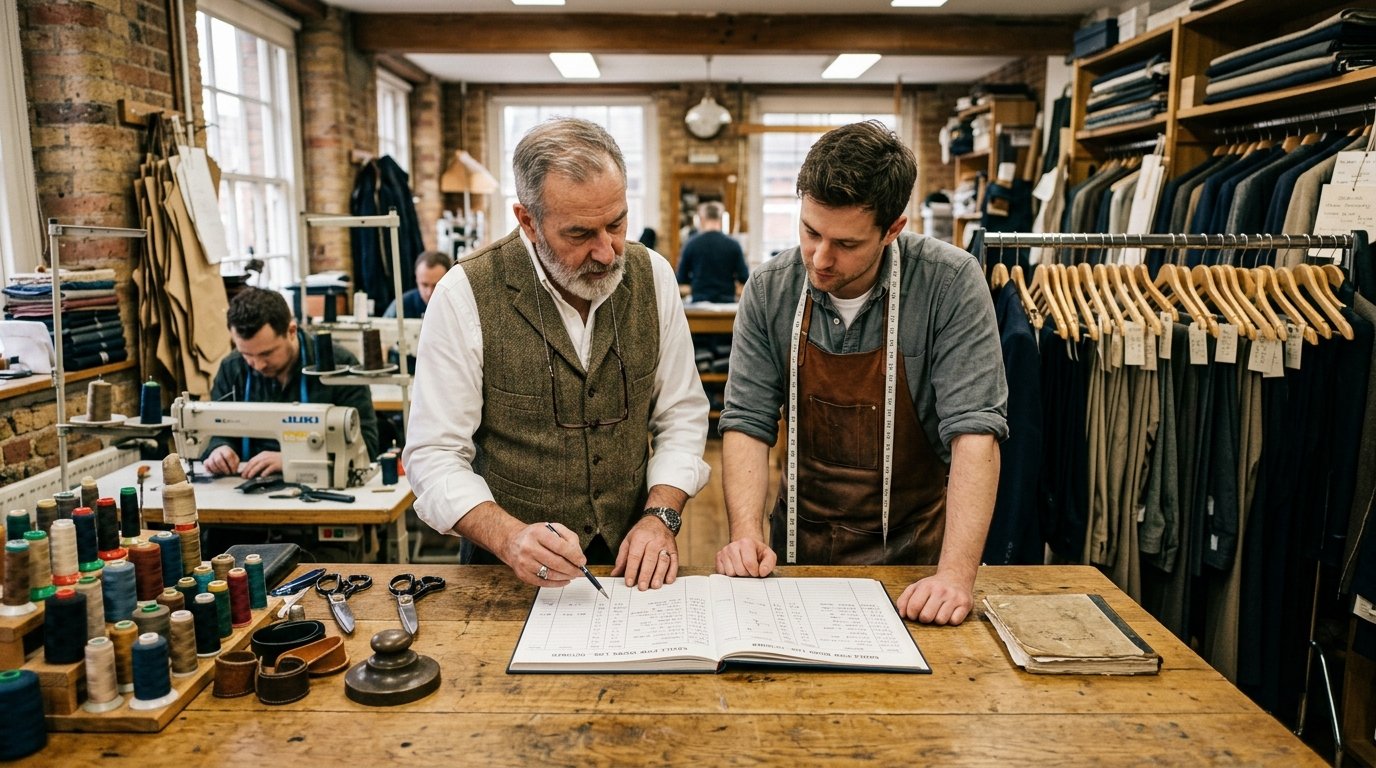
A loyal customer who orders a silk trouser suit at Store A visits Store B the following month. Because Store B uses a different master cutter with different drafting techniques, the trouser rise and shoulder slope fit noticeably differently. The client loses trust in the brand's consistency.
2. Severe Machine & Labor Utilization Imbalance
Store A experiences a massive rush due to local wedding bookings, with 40 orders backlogged and tailors working 14-hour days. Meanwhile, Store B is having a quiet week, with tailors sitting idle on full monthly salaries. You cannot easily balance the workload without physically ferrying fabrics across town.
3. Expensive High-Street Real Estate Wastage
High-street retail rent can easily cost $45 to $120+ (₹250 to ₹600+) per square foot per month. Using 400 square feet of premium showroom footprint to store industrial sewing tables, fabric scrap bins, and iron boilers is an enormous financial drain compared to operating an industrial workshop in an affordable suburban zoning district.
The Hub-and-Spoke Atelier Architecture
The most profitable bespoke apparel chains—from London's Savile Row tailoring firms to leading Indian bridal houses—adopt the Hub-and-Spoke model:
- The Spokes (Front-of-House Showrooms): Located in prestigious retail districts (malls, designer high streets). Designed exclusively for customer consultations, fabric swatch presentation, styling advice, 3D measurements, and trial fittings. Zero sewing machines on-site other than an emergency alteration iron.
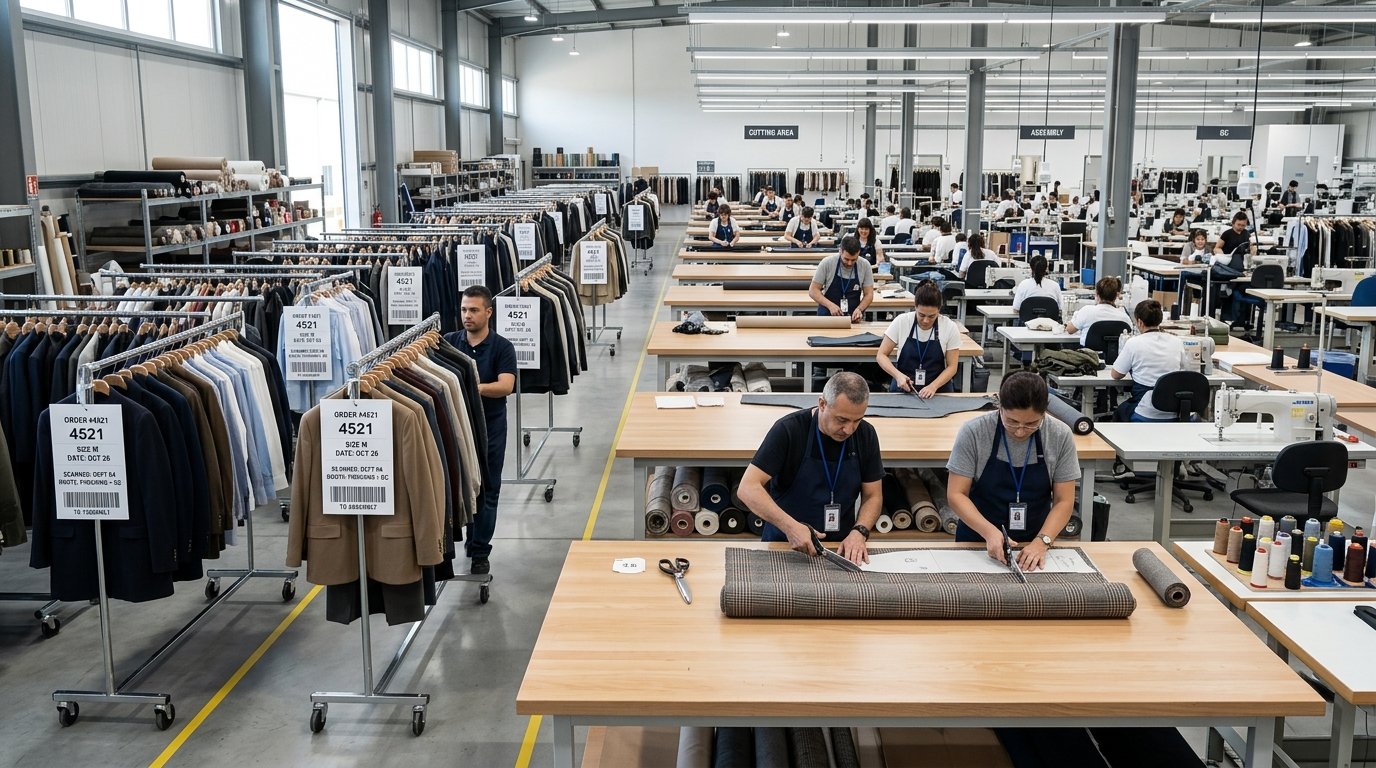
- The Hub (Central Production Factory / Karkhana): Located in an affordable light-industrial zone or low-rent district. Equipped with high-speed cutting tables, computer-aided pattern plotters, heavy-duty industrial single-needle machines, specialized embroidery frames (addas), and vacuum steam press tables.
Barcode Tracking: Eliminating Lost Garments Between Branches
The greatest fear when decoupling retail stores from the workshop is: "Where is Mrs. Kapoor's bridal lehenga? Did it get sent to the workshop, is it sitting on a van, or was it delivered back to the wrong store?"
To eliminate missing garments, high-performing fashion brands use barcode and QR code job cards:
- Store Intake: The stylist takes measurements and attaches fabric swatches. The system generates a weather-resistant thermal job ticket with a unique barcode (e.g.,
BM-ORD-8492-01). - Dispatch to Hub: Showroom staff scan garments into a digital "Daily Dispatch Batch". The van driver signs off digitally on the batch transfer.
- Intake at Hub: The workshop supervisor scans each barcode upon arrival, automatically marking the order as "Received at Central Factory" in the cloud database.
- Production Line Progression: Barcodes are scanned at each station:
- Scanned by Master Cutter → Order moves to "Cutting Complete".
- Scanned by Karigar → Order moves to "Assembly / Stitching".
- Scanned by Quality Checker → Order moves to "QC Passed & Steam Pressed".
- Return to Origin Showroom: Garments are bagged, barcoded into the return courier container, and marked "Ready for Client Fitting" the moment the showroom team scans them at store check-in.
Centralized Fabric & Trim Inventory (Bill of Materials)
When operating multiple locations, managing raw materials (linings, canvases, YKK zippers, designer laces, threads, and buttons) in separate stores leads to duplicate purchasing and immense capital tie-up.
By centralizing your inventory warehouse at the production hub:
- Bulk Purchasing Power: Purchase premium cotton linings, canvas rolls, and fusible interlinings in bulk rolls (100+ meters) at wholesale discounts of 30% to 45%.
- Automated Bill of Materials (BOM) Deduction: When a showroom books a 3-piece bespoke suit, the central system automatically reserves 3.2m of wool, 1.8m of cupro lining, and 1 horn button set from the central warehouse.
- Zero Shrinkage: High-value pure fabrics (raw silks, georgettes, cashmere) remain under the supervision of a dedicated central inventory custodian rather than sitting unaccounted for on showroom shelves.
Centralized Performance Metrics & Tailor Analytics
Operating a single hub allows you to establish true industrial production benchmarks that are impossible in small retail backrooms:
| Key Performance Metric | Decentralized Stores | Central Factory Model |
|---|---|---|
| Average Cutting Speed | 45 mins per garment (individual manual drafting) | 18 mins per garment (batch cutting & pattern libraries) |
| First-Fit Trial Accuracy Rate | 72% (varies wildly between store staff) | 94% (standardized master drafting formulas) |
| Alteration Turnaround Time | 5 to 7 days (clogs store fitting queue) | 24 to 48 hours (dedicated quick-fix express team) |
How Boutique Manager Powers Multi-Store Enterprises
Boutique Manager is built from the ground up to support modern multi-store fashion chains and central production facilities:
- Multi-Branch Cloud Architecture: Manage multiple retail branches and central production karkhanas from a single dashboard. Restrict staff permissions so store sales stylists only see their branch orders, while the production head oversees factory queues.
- Inter-Branch Transfer Workflows: Seamlessly dispatch orders from Store 1 or Store 2 to the Central Workshop with automated digital manifests and barcode verification.
- Central Production Kanban Board: Monitor hundreds of live garments across cutting, embroidery, assembly, quality control, and transit in real-time.
- Unified Financial & Payroll Reporting: Consolidate multi-branch sales revenue, customer deposits, VAT / GST liabilities, and artisan piece-rate payouts into one-click executive reports.
Scale Your Fashion Brand Across Multiple Stores Seamlessly
Unify your retail showrooms and central production workshop on Boutique Manager's enterprise platform.